
Whether you prefer the bright lights of a big city, or a peaceful country retreat, rest assured that if you choose to move to France, you’ll find the ideal area that suits your needs and requirements.
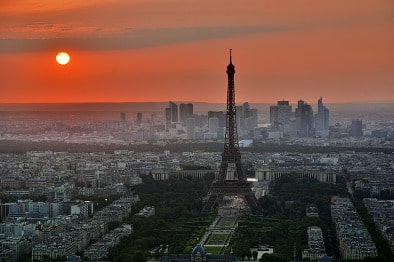
Paris
- Pint of beer: 7 EUR (£6.30)
- Cappuccino: 3.67 EUR (£3.30)
- Meal in a restaurant: 15 EUR (£13.50)
- Monthly public transport pass: 75 EUR (£67.50)
- Population: 2,161,000
Any expat in Paris will tell you that living there is entirely different from visiting as a tourist. However, its history and charm shines through, making Paris a rather popular choice for expats settling in France.
The City of Lights is full of opportunities, and is a major hub for fashion, arts, finance and science; as well as being home to many international organisation headquarters, including UNESCO, and the International Chamber of Commerce.
When it comes to finding a place to live, you’ll need to choose an arrondissement. The 11th and 17th arrondissements are popular amongst professionals, whereas the 12th, 15th and 16th arrondissements are more family-oriented. If you’re looking for an expat feel, then the 14th arrondissement is the ideal place.
Marseille
- Pint of beer: 5.50 EUR (£4.95)
- Cappuccino: 2.66 EUR (£2.39)
- Meal in a restaurant: 13 EUR (£11.70)
- Monthly public transport pass: 48 EUR (£43.20)
- Population: 861,635
If you love the bright lights of Paris but yearn for sunnier climates, then Marseille is the ideal alternative. Part big-city, part sleepy fishing port, Marseille has undergone a huge transformation over the years.
Hugely popular with expats in France because of the large expanse of R&D positions, despite having a higher than average unemployment rate of 12%, there are still many opportunities here.
When it comes to choosing where to live, Longchamp in the fourth arrondissement is popular amongst families, whereas Cours Julien is a favourite with professionals.
On your weekends, you’ll be able to while away the time at the Old Port, hopping between the different cafes and restaurants; or if you’d prefer to go somewhere further afield, head to Calanques National Park to discover beautiful views of the Mediterranean Sea.
Strasbourg
- Average house price: 250,000 EUR (£225,551)
- Pint of beer: 5.25 EUR (£4.73)
- Cappuccino: 2.69 EUR (£2.42)
- Meal in a restaurant: 10 EUR (£9.05)
- Monthly public transport pass: 50.90 EUR (£45.81)
- Population: 277,270
Look at the twee timbered buildings and you might think you’re in a quaint German town, but that’s what makes Strasbourg so unique: nowhere else will you find a place that embraces its fusion of France and Germany.
France’s second largest financial hub after Paris, it accounts for two thirds of total jobs in the city; with The University of Strasbourg a large employer too.
You’ll likely spend most of your time off in Strasbourg’s beautiful Old Town, complete with an imposing Gothic cathedral; or sampling the flavoursome Alsatian cuisine, such as tarte flambee.
This communication is for informational purposes only and is not intended to constitute, and should not be construed as, investment advice, investment recommendations or investment research. You should seek advice from a professional adviser before embarking on any financial planning activity. Whilst every effort has been made to ensure the information contained in this communication is correct, we are not responsible for any errors or omissions.
 It’s no surprise that France is a popular destination choice for British expats looking to spend their retirement years overseas. From its beautiful pastoral landscapes to its quaint cobblestoned streets, settling into a new life in France is like living in a Claude Monet painting.